
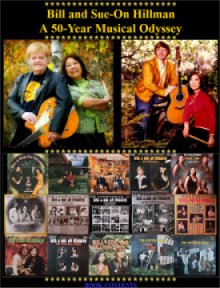
BILL and SUE-ON HILLMAN: A 50-YEAR MUSICAL ODYSSEY


www.hillmanweb.com/book
Presents
Stage 5
A Prairie Saga in Song
www.hillmanweb.com/book/saga
A Concept Album :: Words and Music by Bill Hillman
We have written and recorded about 50 original songs and many of them have been somewhat autobiographical in nature. Our most concerted effort in this direction came with the recording of our PRAIRIE SAGA concept album. It opened with a tribute to the various North American Indian tribes and went on to a song inspired by my grandparents who settled on our homeplace in 1878. The album continued with the fond memories I have of growing up in a prairie farm community and my love for this part of the world.The saga of this +50-year-long journey really comes alive though, with the arrival of my partner in life and love and the memories of our performing years and music tours together. All of this is segued with our devotion to family and our various "day job" careers. I've included an introduction to each set of lyrics as well as links to the actual recordings.
We dedicate this "Saga" to our three kids -- Ja-On, Robin and China-Li -- who were with us for much of this long journey -- but I'm sure many of the experiences that unravel here will perhaps provide them with a deeper insight into what makes "the old folks" tick.
CONTENTS :: ORIGINAL SONGS
Story and Lyrics :: ListenMASSACRE :: PLAY
PUKATAWALKIN' BLUES
JOHN CAMPBELL - PIONEER :: PLAY
MEMORY TAKE ME BACK :: PLAY
HARVEST :: PLAY
CHINA LADY :: PLAY
CHINA SONG :: PLAY
A SAD COUNTRY LOVESONG :: PLAY
HIGHWAY 354 :: PLAY
MONTANA :: PLAY
SWAMP ROMP :: PLAY
GOOD-TIME JAMBOREE :: PLAY
ONE NIGHT STAND :: PLAY
OUTLAW RAMBLIN' BAND :: PLAY
REELIN' IN SOHO :: PLAY
SAIL ON 747 :: PLAY
HILLMAN EXPRESS :: PLAY
SEAQUEST
Both Sue-On and I are educators. Two of our favourite subjects have been geography and English. One reason for the creation of Massacre was to show students how native Indian place names have enriched our North American landscape. In addition to serving as a tribute to those who came here generations before my ancestors, I felt that the writing and recording of a song using colourful Indian names was an excellent way to enhance my teaching. As you can hear in the lyrics, I tried to string together the fascinating names of Indian tribes in a lyrical and rhythmic way. 
MASSACREWe enjoy doing this song on stage -- and I guess the performances which stand out most in our memory were the times we sang it in the back-to-nature setting of the Boggy Creek Call of the Wild Country and Bluegrass Festival. We were quite involved in the event for many years, both as performers and organizers.
Our appreciation of Canadian aboriginal heritage was further enhanced during my four-month teaching assignment in Northern Manitoba on the Pukatawagan First Nations Reserve. I was teaching university courses on a Brandon University satellite campus. The University regularly flew me to Puk and back. Following this I was assigned an permanent office on the BU campus, but my northern adventure was an unforgettable experience.

Granddaddy
told of times
He
saw men dying
Old
women weeping,
Naked
children crying
Blankets,
trinkets
For
land and gold
Ain't
nothing left
But
memories to hold...
For
the...
Chorus
Chickasaw
Waccamaw Iroquois Sioux
Susquehanna
Missisauga and the Kickapoo
Choctaw
Chippewa Yakima Cree
Sissipahaw
Wichita and brave Pawnee
Then
we chopped down the trees
And
poisoned the breeze
Killed
all the beasts and
Brought
nature to her knees
Now
rivers are dying
Too
heavy to flow
Proud
people crying,
Nowhere
to go...
For
the...
Cherokee
Apache Mohave Mandan
Shawnee
Comanche Miami Cheyenne
Apalache
Muskogee Tutchone Navajo
Missouri
Shoshone and proud Arapaho
A few years ago, one of my job assignments as a professor at Brandon University was to spend four months teaching computers and journalism in the BU classroom at Pukatawagan -- a remote First Nations community in northern Manitoba. There is not much entertainment in Puk in the middle of winter, but I had my guitar with me. There is something about the isolation of Puk that lends itself to singin' the blues. Pukatawalkin' Blues is the result of that experience.
PUKATAWAGAN BLUESMy next-door neighbour, Sidney Castel, was a sort of local celebrity. NCI Network Radio played his single, The Pukatawagan Song, in constant rotation. I was spending much of my time researching Puk history and scanning vintage photographs of Indian life in the North. Most of the photos were brought in by students from their personal collections. To add a bit of colour to this project I invited Sidney to my class to relate his life experiences in the North and to answer questions about his stage and recording experiences as a native performer.
The session ended in a "guitar pull" singing session where I performed my Puk Blues in answer to Sydney's Puk Song. He related his string of misfortunes concerning guitars. His wife, in a jealous tiff, had kabonged him over the head with his first instrument when she thought he was paying too much attention to some of the ladies during one of his bar performances. His second guitar had been stolen. Sadly, Sidney died a year later, but I'm sure that the memories of this event touched everyone involved.
I joined the local band for a few social events and when my 30 adult students learned I was doing a show with longtime Canadian pop idol Bobby Curtola after I returned to the Southland they started to raise funds to pay for their trip down for the show.
PUKATAWALKIN' BLUES
Travellin’
Professor is what they call me now
Travellin’
Professor means you’re never sittin’ down
CHORUS
I
keep a walking… Walkin’ to the Northern Store
I
got the Pukatawalkin Pukatawalkin Blues
My
luggage flew to Churchill - no socks for my feet
My
grub's up with the polar bears and I’m getting awful weak
Hey,
Hey buddy - Tell me where’s the store
Ya
justa keepa sloggin’ - Only five miles or more
Waitin’
for the phone man - Bout a month or more
Says
I’d like to help you - But I been that way before
Winter
roads are scary - Ice is breakin’ up at Puk
Roll
your windows down - You’ll catch some fish with any luck
Water
lines all froze up - Not a drop for tea
Doin'
my flushin' and my washin' - Down by the Missinippi
My
neighbours all got TV - I got NCI
Neighbours
cook with microwaves - I’m eatin’ old cold pie
Walkin’
to the airport - The plane won’t go
Man
sez don’t ya know - It’s 44 below
My great grandfather came west in 1878 with his family and possessions to homestead a tract of land south of the Little Saskatchewan River Bend settlement -- near the present location of Strathclair. I was raised on this farm and we still maintain a home on this homestead site. This song was written as a tribute to those early pioneers. Besides trying to express our love for this area where my ancestors sank roots so long ago, I was also trying to show how much I feel we owe to our heritage.
JOHN CAMPBELL - PIONEERThe family and local history research that inspired this song served me well a few years later. I've had a long association with Brandon University -- going back to 1961 and in more recent times to work on staff as a Professor. I was commissioned by the Geography Department to contribute a chapter to a university textbook. I expanded many of the themes in "John Campbell - Pioneer" and "Memory Take Me Back" in the writing of my chapter. The result was:
THE GEOGRAPHY OF MANITOBA: ITS LAND AND ITS PEOPLE
Strathclair: A Prairie Town with a Past, Present & Future
EVOLUTION OF THE STRATHCLAIR DISTRICT
William G. Hillman, B.Sc.(Hons), B.Ed., M.Ed.
Assistant Professor ~ Brandon University, Brandon, MB Canada
Westward
bound the year was '78
John
Campbell - Pioneer
Steamin'
by train and rolling by wagon
To
Manitoba's wild frontier
His
daddy built a house of sod just for the winter
Come
summer built a house of stone
Cleared
the virgin land and they did it by hand
Workin'
aching fingers to the bone
He
met my Nanny in a country school house
Where
they danced the night away
Bought
a gold band and asked for the hand
Of
pretty little Katy McKay
Green
Bluff girl then moved into Maple Grove
Just
a little south of town
Helping
in the fields and cooking all the meals
And
watching little babies run around
Chorus
Now
I walk the same fields and the forests
But
it's not as it once used to be
And
I realize with tears in my eyes
Time
fades their memory
'20s
brought good times, '30s took them back
'40s
called the second son away
Winter
'55 took and old man's life
And
a woman's will to live another day
But
the house still stands to the memory of a man
Who
settled on this prairie land
Trees
a-blowing in the wind are still growing
Planted
by a woman's loving hand
The glory years of Strathclair and many other similar prairie communities reached their zenith in mid-twentieth century -- the '50s decade. The excitement and spirit generated by these towns was perhaps best epitomized by the Saturday Night "event." Following the Saturday evening supper hour, families would prepare to "go to town."
MEMORY TAKE ME BACKThe first cars to arrive would get the best seats. This meant finding a diagonal parking spot along the north side of main street (North Railway Street) in the well-lit, high-traffic area extending from the pool room at Minnedosa Street to the modern 'self-serve' department store at Campbell Street. Between these termini, people of all ages walked a jostling gauntlet along a strip of thriving businesses.
Three favourite spots were the drugstore with its soda fountain and magazine rack, the Chinese cafe‚ with its booths for socializing, and a rival eatery which featured a jukebox, pinball machine and lunch counter with stools. Many of the men gathered in one of the two male bastions -- the beer parlour and the pool room; while a favourite routine for the women was to peruse the line of parked Fords, Chevies and Dodges -- each vehicle demanding a nod, wave or a detour off the sidewalk for a chat. When the week's discussion lagged out on the street, there seemed to be no end of open doors to shops to provide diversion: bakery, grocery, dry goods store, newspaper office, garages, butcher shop, hardware store, restroom, shoemaker, and tinsmith. In the winter there was always skating, curling and hockey at the rink.
The routine for some, and certainly for myself, was to go to the 7 o'clock movie at the Bend Theatre, delaying the sidewalk promenade for later. From a thirty-five cent allowance, kids could eke out a full night's entertainment which included a movie (complete with newsreel, Three Stooges short, cartoon, serial, previews, and draws for prizes), popcorn, "coke" or popsicle, double bubble gum, jawbreakers, and a fifty-two page or 3-D comic book. Later in the decade, many people gathered outside the electric shop which provided an outdoor speaker connected to the twenty-one inch television in the window, few realizing that this box with its flickering black and white pictures was a harbinger of drastic change to this weekly social phenonemon that everyone took for granted.
Mother's
mother on the porch where she's makin butter
Grandfather's
out in the yard where he loves to putter
Screen
door slams -- sister runs in crying
Skinned
a knee out where the collie dog's lying
Memory
take me back just one more time
Daddy's
in the field where he keeps the prairie dust flying
Rain
don't come but the clouds keep on trying
Though
drought and hail made times a lot tougher
A
mother's love saw that we didn't suffer
Memory
take me back just one more time
Saturday
night Daddy takes us into town for a movie
Late
night shopping and farm talk swapping on Main Street
Old
men standing by the pool hall talking
Young
folks out on the sidewalk walking
Memory
take me back just one more time
The lyrics pretty well tell the whole story of this song. We were trying to create, on record, a bitter-sweet feel akin to the moods of Autumn on the prairies -- and our country home: the cool fall breezes, birds migrating to the south, stubble fires, falling leaves, harvest moon, dew turning to frost, shortening days. All of this contrasting with the strangers, loneliness of crowds, and pollution associated with urban living. If we succeeded in this I believe we owe it to Sue-On's wistful interpretation.
HARVEST
Sun
shinin' brightly
Cold
wind blowin' free
Old
mallard's winging
His
way from the north
Smoky
air sweeping
Through
tired leaves weeping
Prairie
life singing
A
song to the north
When
the brown city air and
Cold
sidewalk stares get me down
I
reach for the days and
Old
time ways of the farm
Memories
so warm,
Of
the place I was born, I recall
Harvest
time
And
dandelion wine in the fall
Stubblefields
burning
Old
windmills turning
Silhouettes
framed by
The
sun's fall to earth
Dew
crystallizing
Harvest
moon rising
October
night singing
A
song to the north
This song was written as sort of metaphor. It was inspired by memories of the rather difficult time that Sue-On and I had during our three year courtship. One of the obstacles we faced was Sue-On's being sent to live and work with relatives for a year in distant Winnipeg. This attempt to separate us was not successful, but it was often a sad and stressful time for both of us. We were able to marry when Sue-On turned 18 . . . the start of a long and beautiful journey. A true love story.
CHINA LADYWe have had a long relationship with oriental culture. We have a deep respect for oriental art, music, traditions and martial arts. Our living, recreation, and work areas are all adorned with Chinese art and furnishings, of which the Chinese moon door on the cover of CD Vol. 10 is a good example. This appreciation of 'the East' has carried over into other areas as well. As a family sport and discipline we studied Wado Kai Karate -- a martial arts style developed by Supreme Instructor Masaru Shintani, 8th Dan. Under the instruction of Sensei Bruce Dunning, we have both achieved the rank of 1st Degree Black Belt.
We assembled our regular Canadian cast of characters to record this one at Century 21 Studios -- a very up-to-date facility housed in a converted synagogue in Winnipeg's North End. This entourage was made up of musician friends we have worked with for many years: Alan Jones is a physiotherapist, musician and songwriter blinded as a child in wartime England. We encouraged him to try to get some kind of an oriental sound out of the massive Yamaha studio organ. Kevin Pahl is daredevil cropduster and musician extraordinaire who did a fine job at eking a vibes/celeste-like sound out of the Fender Rhodes piano. Barry Forman a champion fiddler, car dealer and former teacher thumped away on bass -- a task he performed so many times on our sessions. Sue-On and I were singing while playing drums and guitar.
Meanwhile, engineer John Smith -- who had worked with the Beatles at Abbey Road and had received a credit on their double White Album -- tried to pull it all together in the control room. Also sitting in at the console for this session was another musician friend -- Kerry Morris -- pilot, hang glider, computer systems analyst - who joined us a few years later as our regular bassist and drummer.
O
China Lady
Though
you are far away
You're
haunting me night and day
With
your laughing eyes
O
China Lady
In
every dream I see
A
vision of you and me
Under
China skies
When
the moon shines
Through
the prairie sky
And
the cold wind wails
And
calls your name
I'm
on some foreign shore
By
the ocean's roar
Long
ago - Far away
O
China Lady
I'm
living in misery
Surrounded
by memories
Of
our last goodbye
I wrote China Song with considerable help from Sue-On -- if you listen closely it should be easy to pick out her contributions -- I am not exactly fluent in Chinese. From our first meeting I have been constantly amazed at what this person -- my soul mate -- is capable of achieving.
CHINA SONGSue-On was born in southern China, but her family lost everything there during the Communist Revolution. At age two she was smuggled out of China with a neighbour family and lived with her grandmother in Hong Kong until her mother and siblings were able to follow. Eventually, at age 10, she and her mother were allowed to join her father in Newdale, a small prairie town in Canada, where he and his father had owned restaurants for many years. She mastered English and adapted to the new culture while working in her family's restaurant.
After we married she joined me in performing on stage -- singing, and playing drums and keyboards. She then completed University (BA, B.Ed) and worked as a high school teacher, as well spending time as a Field Supervisor for the University of Manitoba and Brandon University -- all this while maintaining a frenetic performing schedule and raising three kids. When we took over the long-established Choy family restaurant -- SOO's in Brandon -- she added the role of restaurant manager and entrepreneur to her slate of accomplishments. We sold the restaurant after ten years and Sue-On resumed her role as an educator. This time she worked as an English for Academic Purposes instructor at Brandon University -- teaching international students from all over the world. Not the least of her achievements has been her ability to put up with my idiosyncrasies through all these years.
It is ironic, considering all the trouble Sue-On's family had in getting out of China that, for a while, Beijing became one of our largest radio audiences. Sue-On's brother-in-law, Wai Kai was captured by the authorities after having paid to be smuggled out of the country by boat. It was 17 years before he was able to join his wife and daughter in Canada. After coming to Brandon, he stayed in touch with a friend who had been assigned the job of music programmer for Radio Beijing. When China relaxed its ban on 'things Western,' there was a great thirst for music from America and some of the first imported tapes they heard were ours -- Choy revenge?
CHINESE LYRICS ............
A SAD COUNTRY LOVESONG
This song is sort of a typical lonely bar song, but it is somewhat autobiographical.
Sue-On and I had a long courtship and we faced many obstacles that kept us apart for over two years.
We
met in a small prairie dancehall
We
danced till the dawn's early light
I
held her close as we whispered
The
words to each song that night
Now
I sit at this bar in the city
Fame
and fortune I've found
But
my thoughts all drift to the homeplace
A
girl -- and a prairie town.
For many years we were based in our Maple Grove country home on Highway 354 near Strathclair. I taught high school through the week and we spent the weekends on the road driving to gigs all over Manitoba and into Ontario and Saskatchewan. We had quite an obsession with all things musical: weekend gigs, songwriting, recording, radio/TV, and summer tours which took us all across the prairies and even farther afield to the USA and UK.
HIGHWAY 354
Slam
the car door
Highway
354
Gonna
take me from a week of 9 to 5
Love
that highway sound
Lonely
Manitoba towns
Lights
and truckers, weekend lovers flying by
Chorus
O
I can take it, think I'll make it
Even
though it takes a mighty long time
O
I'll keep shakin' and fakin'
And
rakin' in the dollars and dimes
Gimli
Carman Dauphin
Brandon
Shilo Austin
Then
on the road and home to Maple Grove
McCreary
Minnedosa
Portage
Wawanese
I'll
keep makin' records - Looking for gold
Nine
to five a day job
Only
in the way job
Longing
for the weekend show
Nine
to five a day job
Just
a slavin' pay job
Dreaming
'bout another life I know
We have spent many summers touring Western USA and Canada -- performing with American acts on grandstands at rodeos and State, Provincial and County Fairs. Many acts were from Nashville, but the ones we found most interesting were the variety acts from California.
MONTANAOur US booking agents were the Bardines who were veterans of the last days of Vaudeville, so it was not surprising to find a multitude of fascinating, experienced acts on the bill. We rubbed shoulders with, and took show biz lessons from, magicians, ventriloquists, comedy pickpockets, trick cyclists, dancers, standup comics, tenor banjo players, chorus girls, singers, acrobats . . . the gamut.
When we were not listening to inside stories about Greats such as Bob Hope, Ed Sullivan, and the Marx Brothers, we basked in the aura of enthusiasm that surrounded these seasoned entertainers. All of this played out against an almost incongruous backdrop of the 'wild west.' Inexplicably this, coupled with my love for geography and heritage, seemed to pull me back into the traditions of the western setting we were touring - hence this song.
We tried to convey some of the Montana Big Sky feel through some unusual studio effects which included flanging the strings and fading the ending with a lonely wind effect.
Rolling
down the highway -- we're southern bound
Wind
from the bus blows the sweet grass 'round
Kalispell,
Missoula and their rodeos
Play
a little fiddle and a dosey doe
Dancing
and prancing -- the ponies a-flying
Cowboys
cussing and their ladies a-crying
Pick
a little tune, a jig and a song
Montana
crowd wanna sing along
Chorus
Montana
Your
song goes on
Echoing
through the sky
Montana
I'll
sing your song
Till
the day I die
Phantoms
and shadows on the far horizon
Stories
of the redman and herds of bison
Railroad,
wagon, trader and miner
Lawman,
outlaws, and old moonshiners
Shaken
outa my dreams by the tires a-whining
Just
another sound of the Old West dying
Can't
live the past but I'll sing it in song
Kindle
old times as we roll along
For many of our years on the road our bass player, Barry, doubled on fiddle. So I wrote a number of songs to feature his electric fiddle which he played through numerous effects such as a wah-wah pedal. This, and our fondness for artists such as CCR and Doug Kershaw, led us to an appreciation of swamp and Cajun music. As a result, some of the songs I wrote were with these themes in mind so as to feature his fiddle.
SWAMP ROMPBy the time we recorded this song in England, however, Barry had left the band, so it was adapted with quite a different feel. It does give a nod though, to the great diversity of audiences we have entertained, the many distant places we travelled to, and our ongoing search for distant horizons.
We've
sung of Alabama -- Louisiana too
Montana
where we paid our dues
Manitoba
gold and Saskatchewan dust
Sunday
in Alberta - yeh we cussed and cussed
We
bin up and down
Round
and round
We
keep movin'
We
bin north and south
Town
to town
We
keep a groovin'
We
keep setting our eyes
On
another horizon
To
follow
O
we fly to Toronto -- Fly to LA
Hustlin'
all night -- And bussin' all day
Fly
to the East -- Fly to the West
England
swings, we think it's the best
Long
Hair, Redneck and Leisure Suit
We
love 'em all -- we don't give a hoot
Hustle,
Bump and Boogie and Texas Swing
Just
hum a couple bars and we'll pick that thing
This is a novelty song about our stage exploits and the experience of performing many decades worth of one-nighters.
GOOD-TIME JAMBOREEIt was recorded during our Newcastle sessions in England. This studio, like so many of the places we played in England, was inaccessible in the extreme. We had to pull our gear up many flights of stairs and through a seemingly endless number of doors because the facility was situated on the upper level of a large bingo hall complex.
After surviving this ordeal which anyone in his right mind would have left to roadies, I returned to re-park our Ford Transit van only to find that the meter maid had decorated it with a parking ticket -- to add infuriation to fatigue.
Chorus
Come
on and give the band a hand on the ole bandstand
They're
singing all night for you
Guitar's
ringing and the drummer girl's singing the blues
We'll
pick a little fiddle and diddle
with
the ivories in harmony
We'll
have a rompin' stompin' good-time jamboree
Forget
your tax laws, in-laws, out-laws, too
Even
Grandma's jumpin' like new
Dancing
and prancing -- any ole dude'll do
Dancing
outside, inside, upside-down
Look
-- her feet don't touch the ground
Struttin',
double clutchin', and
hitching
up her gingham gown
The
amp'll stapple crackle pop when we start to rock
You'll
feel your toes tapping down in your socks
Skippin'
and trippin' and rocking around the clock
We'll
keep you creepin' and peepin'
--
anything but sleepin'
Till
the moonshine meets the sun
Then
you'll drag it to your wagon and
The
band's on the run again.
This autobiographical effort was written during a rather laid-back and reflective mood. Although we tour far afield most summers, the remainder of each year is spent playing one-nighters. The experiences we have shared while performing in a different town every night has developed bonds with which only musicians can identify. The fact that we are married has seemed to intensify marital bonds as well. Our closest lifelong friends have always been musicians and some of our most cherished moments could only have come about through our performing experiences.
One Night StandDovetailing other careers with our music has been the source of some frustration over the years -- family and teaching careers have always come first. This has meant that we have not always been able to follow up music opportunities, but the moment we step on stage, any stage, the rush of performing kicks in -- a cure-all for all maladies.
One Night Stand was recorded at Impulse Studios at Walls End in Newcastle-On-Tyne, England. The studio is located close to the eastern limit of Hadrian's Wall -- a wall built by the Romans to keep out the wild Scottish tribes. The wall was not too successful in holding back Scots from the studio ... we invaded successfully, as did quite a number of Celtic groups, such as the Chieftains, who used the studio regularly.
These Newcastle Sessions came about at the end of our second tour of Britain and resulted in 14 songs for Album #7. One Night Stand was culled as a single and was our first charted song to break the Top 10. We eventually performed it on the CBC network-televised Canada Country Music Week concert at the Winnipeg Centennial Auditorium - backed up with a 20-piece orchestra. Our fondest memories of this event, however, centred around our backstage bull sessions with fellow entertainers George Hamilton IV and The Family Brown, swapping stories about performing in England.
Make
the same ole rounds
Hit
the same ole towns
Picking
Country and Rock 'n' Roll
Crowd
gettin' loud
Band
gettin' louder
Till
the whole thing's outa control
Hey,
Hey Alright
Gonna
be alright tonight
We
boogie all night
Watch
'em brawl and fight
People
never listen like they should
They
want the same old songs
Say
there ain't nothing wrong
With
'Roll Over...'
...and
'Johnny B. Good'
Chorus
It's
a one night stand
And
we're standing up for rock 'n' roll
Fifteen
years
Of
smoke and beers
And
fifteen thousand bars
Nights
get lonely
When
you're on your own
With
nothing but your old guitar
It's
a one-night stand
And
we're standing up for rock 'n' roll
I wrote this around the time that the Nashville "outlaw" music was in vogue and we had started our annual music tours of England. As we got further into our tours the image seemed to fit. We did a variety of Country Rock which wasn't being done my many English performers at the time, but threw in a few Shadows and Lonnie Donegan numbers. We were a long-haired, "American" sounding, gang of three decked out in rugged, chamois leather patch outfits. We had actually bought these outfits in a little specialty shop just off London's busy Oxford Street. We worked most gigs there as a trio, but our friend Alan Jones joined us in clubs that had a Hammond on stage. Most of our amps were Traynor, since we were sponsored by this Canadian company. After landing at Heathrow we picked up our equipment at Wing Music in Bromley, Kent and made the trek to England's Northeast. Kevin Pahl played a stack of Hohner keyboards, Sue-On played Rogers drums and I played my Fender Telecaster with my self-designed, patented B-bender. We played a different club every night -- and were enthusiastic tourists through the day. We wound up every tour with recording sessions in London, Newcastle and Pity Me, near Durham.
OUTLAW RAMBLIN' BAND
We're
a travellin' ramblin' outlaw band
Kevie,
me and Suzy we travel the land
We
kinda got our minds a-set on leaving the West
This
prairie-land rebel band a-flyin' the nest
Took
a 747, ride to heaven by jet
The
closest that the most of us is ever gonna get
Heathrow,
luggage slow -- we fuss and we fret
Sue,
she's in the loo - she's trying to get her face wet.
Chorus
'Cause
we're outlaws -- an outlaw ramblin' band
Outlaws
-- Outlaw ramblin' band
Tea
time, cars in line on Westminster Bridge
It's
scarey for a prairie boy from Bunclody Ridge
Ride
the M-5 -- still alive -- we're steaming up north
Workin'
for the workin' man to show our worth
We
bring on Lonnie Donegan -- they clap and they stomp
And
we sing a little song about an ole Cajun swamp
We
rant about Canada - we pick and we sing
They
can't understand 'American' -- "What's he sayin'?"
We're
with the crowd -- singing loud -- yeh, we're starting to rock
When
Housey Man, up on the stand, says, "I say Chaps - Stop!"
It's
dour hour, holy hour -- time to unwind
Bingo
is the single thing they got on their minds
Thirty
nights of flashing lights -- the end of the grind
Heading
down to London town for studio time
Suzy
drums, Willie strums in old Soho
Kevin
just a revin' up the piano
Yeh,
we're a transported, imported semi-deported, genuine, certified
Outlaw
Ramblin' Band.
Reelin' in Soho is an account of our first recording session in London, England. As suggested in the first verse, this was the culmination of a tour in which we -- "The Hillmans From Canada" -- had played over 30 one-nighters in night clubs and discos across Northern England.
Reelin' in SohoMany nights found us in the ubiquitous Workingman Clubs where a house band opened at 7:00 pm, followed by opening acts which usually offered variety entertainment. We would then come on for a show set, after which there would be a long break for housie (bingo) -- a national addiction. After this exciting gambling break we would return for a dance set -- but by 11:00 pm the dancers would call it a night since they had to work the next day.
Being so used to the long drives, long gigs and late nights back in Canada, it was hard for us to wind down so suddenly and every night found us driving around looking for some place which might still be open. We met some very colourful characters on these midnight rambles.
The audiences attended these clubs every night of the week and had seen it all, so it was especially rewarding to 'go down a bomb'... to 'bomb' has a different connotation there than it does in North America. It was tremendously exciting to study the dressing room walls which were festooned with pictures, cards and stickers left by previous entertainers -- even the Beatles, early in their careers, had toured this circuit. These backstage walls were seldom refurbished since it seemed that the more 'name' acts displayed, the more prestigious the club. Perhaps the most fascinating venues though, were the Country and Western Clubs where nearly everyone showed up in full Western regalia -- including boots, hats, gunbelts ... and western drawls -- Geordie cowboys.
Our strangest and perhaps most memorable night occurred at Thirsk -- a village in Yorkshire. Throughout the tour, we spent most mornings and afternoons being tourists - traipsing through castles, cathedrals, and pubs and across highlands and moors. Thirsk, however, offered a special reward because it is home to Alf Wight, aka James Herriot of All Creatures Great and Small fame. We visited his veterinary office and toured his small museum just down the street.
Fittingly, the club we were to play was on the outskirts of town surrounded by a meadow or cow pasture. It was a 1920s pavilion-style hall. Our opening act for the night arrived late -- surrounded by an entourage of people in formal wear. He was a singer who had been married just a few hours before up in Newcastle. This set the mood for the whole evening -- the place seemed to explode and although the club should have been emptied by 11:00, the management barred the doors to keep out the local constabulary and the party continued into the wee hours. When Sue-On wearied of the drums, a succession of people -- our agent, the bartender and even the groom - took control of the sticks. Something right out of the fictional Darrowby.
Warm
summer night in a green Bromley garden
Done
thirty nights of singin' -- runnin' 'round ole England
Picking
out the songs to lay down tomorrow
Songs
about lovin' -- leavin' -- and sorrow
Monday
morning moving into Bromley Station
Munchin'
fish and chips wrapped in the news of the nation
A
Charing Cross stop and then we're out to Trafalgar
Humpin'
piano and draggin' a guitar
Chorus
Rockin'
and rolling and reeling to Soho
Boogie
Woogie Woogie into London Town
Rockin'
and rolling and reeling in Soho
Boogie
Woogie Woogie till we get back home
Huff
and puff and shove to where the lions and pigeons stand
Wave
and jump and whistle -- callin' for a cabbie man
Cabbie
man don't understand or talk Canadian
Drive
around in circles takin' every street he can
Later
in the morning we're reeling in Soho
Rocking
a studio -- ten feet down below
People
on the street are dancing, pushing and shoving
Listening
to the band a reelin' and rocking
This is a Rock-a-Billy flavoured song. My first exposure to rock 'n' roll was through the Memphis Sun Records artists: Elvis, Carl Perkins, Johnny Cash, Jerry Lee Lewis, Roy Orbison, Ike Turner, et al. The excitement generated by these early rockers has been a major musical influence.
SAIL ON 747The idea for the song came during a long wait at London's Heathrow Airport during a work-to-rule strike. Sue-On was pregnant with our first child, Ja-On, and we perhaps were a little nostalgic and homesick after having toured for seven weeks in a foreign land. It had been a very successful tour culminating with the recording of five sides in a London studio, but we have always been 'homebodies,' -- a defence, I guess, from the craziness of the road.
It was approaching harvest time on the prairies and we were looking forward to experiencing our unique fall rituals and even seeing the stubble fires which light up the night skies on every horizon. We had loved the experience of this, our first tour of England -- the Newcastle Brown Ale, the ocean, the history, the Geordies, clubs, football, housie, BBC, Blackpool ... everything -- but it was time for homefires.
The song was recorded three years later at Guardian Studios in northern England, during our third tour of the UK. This 24-track studio was set up in two adjacent row houses on High Street, in the tiny village of Pity Me, just outside the beautiful, historic City of Durham. The studio was a labour of love and brain child of owner/engineer Terry Gavaghan who saw it as a means of getting 'off the road' while still staying in the music industry. He invested the money he had saved touring as lead guitarist for the Carpenters -- here in this quaint little Yorkshire village. This choice of locale was perhaps not as unusual as it might first appear as England's Northeast is saturated with clubs and musicians. In fact, Alan Clark of Mark Knopfler's Dire Straits band played all the keyboards on the 20 songs that came out of those sessions.
We later performed Sail On at the televised Manitoba Association of Country Artists (MACA) Awards during Country Music Week ceremonies where we were backed by a large stage band complete with fully-charted arrangements -- quite a contrast to the small combo approach we took on the record.
Sail
on mighty 747 Sail on, sail on
Sail
away to Manitoba sunshine (Repeat)
Bobbin'
around - city to town England shore to shore
Boogie
Woogie Rock - Tutti Frutti Bop
They
always shout for more
But
there comes a time for home fires
Prairie
skies and nights
Wheatfields
far horizons
Far
off farmhouse lights
CHORUS
Newcastle
Brown Ale - North Sea gales
Wee
cars and Geordie cowboys
Football
- Housie - Telly and sweet tea
Blackpool's
grown-up toys
When the two other members retired from our Western Union band we used the name The Hillman Express for awhile. Eventually we became Bill and Sue-On Hillman. I wrote The Hillman Express as a signature piece for opening and closing some of our shows. Obviously it was meant to play on a train theme . . . just a rockin' dance number to get the audience jumping.
Get
on board
We'll
make you more
Than
satisfied
Whistle
blowing
Wheels
a-rolling
Come
on and ride
Don't
need no ticket
There
ain't no wicket
There
ain't no fee
Our
magic potion
Is
locomotion
And
ridin's free
Chorus
Ride
Ride Ride on through the night
Rolling
on outa sight
Rockin'
Express
Speedin'
through the west
Ride
Ride Ride
On
the Hillman Express
From
prairie sidings
To
those exciting
Bright
city lights
The
music's hummin'
As
we keep runnin'
On
through the night
Don't
need no baggage
We're
gonna manage
To
get it on
To
every station
'Cross
the nation
Come
ride along

SeaQuest
For
most of my 40 years as a University and High School Educator
I
was sometimes compelled to integrate my love of music into my role as an
educator.
The
following song poem / narration was written and performed for
a
graduating class of students and my teaching colleagues.

SEAQUEST
by Bill
Hillman
A
dramatic reading for educators
accompanied
with guitar and rhythm riffs.
MILIEU:
FISHNET BACKDROP - 5 TELEVISION MONITORS - VIDEO WALLPAPER WITH OCEAN MOOD
AUDIO/VIDEO -
KEGS
- CAPTAIN’S HAT/BLACK TURTLE NECK - MOOD LIGHTS -
SHIPS
LANTERNS - CHESTS - SOUND FX - STOOL - GUITAR - ETC.
Sadly,
some navigators seek out little placid tide pools...
...drop
anchor...
...and
sit in tired... creaky-leaky dinghies...
...while
their young passengers look longingly...
...expectantly...
...out
to open sea...
They
yearn for the thrill of the salt spray in their faces
and
the toss of the waves
and
a chance to skim across infinite waters to distant adventures
-- and
to learn the skills to survive on this life sea.
Many
of these tide poolers will either meet disaster
when
they do break out past the breakwaters,
or will
spend a lifetime as land lubbers --
...frustrated...
...angry...
and
haunted with personal devils
which
constantly remind them of what they could have been.
One can
study the theory behind seamanship --
it can
be mastered by most any hotshot yachtsman,
but
the experience of the old salt is invaluable
when
the going gets long... or rough.
He can
read the tides...
...the
stars...
...the
wind...
...he
can talk to life in the deep...
...he
can create a course and navigate it...
...he
can sail by the seat of his pants...
knowledge
recollected allows him
to cope
with each unpredictable crisis along his course.
To the
novice,
the
waves and cycles with which the old salt is so in tune,
at first
appear meaningless or incomprehensible
but
really they are just a part of life's cycle.
Just
as in the oriental concept of yin and yang
where
two complementary forces flow into one another,
so does
night become day...
...season
follows season...
...death
follows birth...

.
BILL and SUE-ON HILLMAN:
A 50-YEAR MUSICAL ODYSSEY
BOOK
COVER
BOOK
CONTENTS
|
|
|
|
|
|
|
|
|
|