Back to opening page
THE REGINA Industrial SCHOOL REPORTS
NOTE: J.G. Milne worked at
the Regina Industrial School Summer 1891 to December 1896 but I have access only to the 1900 report.
However, I believe it supplies adequate
information to support the fact that good and efficient work happened there, by
instructors, support staff, administrators and students.
[Note
to readers: There is some wording in
the Reports that might be uncomfortable for some of you. However, if I changed
it, the reports would lose their integrity. It is so important to remember they
were written almost 126 years ago. I shudder when I think about people looking
back at our civilization 126 years from now, if it lasts that long. Surely, we
hope their response will be, "Forgive them for they knew not what they had
done." ]
Annual Report July 17, 1900
PROVINCE OF
MANITOBA
BRANDON
INDUSTRIAL SCHOOL,
BRANDON, July
17, 1900
To: The Honourable Superintendent General of Indian
Affairs, Ottawa.
Sir,
I have the honour to submit my annual report for the year ended June 30, 1900.
Location -The Brandon Industrial School is situated three
miles northwest of the city of Brandon, about the centre of the hill that once
formed the bank of the Assiniboine River.
Land -There are three hundred and twenty acres of land
belonging to the school.
Buildings -The main
building, principal's residence, farmer's residence, gardener's residence, barn
and stables, two root-houses, ice-house, carpenter shop and bake house.
Accommodation -There is ample accommodation for one hundred and
ten pupils and all the single members of the staff.
Attendance -The average
attendance has been about one hundred and two; we have at present fifty-two
girls and fifty-two boys.
Class-room Work -All pupils attend school for three hours and some
of the smaller boys six hours, five days in the week. Saturday morning all the
girls and boys are at work. The afternoon is regarded as a half holiday, and
used as a preparation day for the Sabbath. The programme of studies authorized
by the department is adhered to, the pupils are graded as follows:
Standard I.. ..
., .. .. .. .. .. .. .... .... 20 pupils
"
II................................ . 33"
" III........... . .. .. .... .. ..
.. 44 "
" IV.....................
............. 6 "
"
V....... ..... ...... ...... .... .... 1 "
Reading, singing
and present day history are made prominent.
Farm and Garden -The farm consists of one hundred and twenty
acres; farming and gardening are considered the most important industries.
Other handicrafts are taught as well as possible with a view to enable the
pupil to do most of his own repairs when he graduates and is engaged in farming
for himself.
The acreage for
the present year as follows:
wheat, nineteen acres; barley, five; oats, forty-three; brome grass, three and
a half; millet, one and a half; corn, one; potatoes, eight and a half; turnips, four and a half; garden,
seven; summer fallow, fifteen; breaking, ten; hay land, eleven; pasture land,
one hundred and twenty; and uncultivated and water, seventy-one.
Industries Taught -The boys are
taught farm, garden and carpenter work. The girls are taught sewing and all
useful branches of household duties, with the object of making them thorough
housekeepers.
Moral and Religious Training - Religious exercises every morning and evening.
The additional services on the Sabbath are morning song service, Sabbath school
in the afternoon and regular evening service. An effort is made at every
suitable opportunity, both private and public, to give lessons on the necessity
of truthfulness, honesty, diligence, carefulness and faithfulness, and also
other principles that tend to build up a true Christian character.
Health and Sanitary Condition -We have had but
one death during the year, and the general health of all has been good; our
drainage system works well and the sanitary condition of the building is
excellent.
Water Supply - Our water supply is good; a large windmill pumps pure spring
water from the well on the hillside into two large tanks on the top flat and
from these water is supplied to all needful points in the main building.
Fire Protection -We have hose
attached to our water-works, and pails at convenient points are kept full of
water. Two Babcock, three Star and other chemical extinguishers are kept for
use. During the year a large McCrobie engine has been placed in the basement, with a
hose of sufficient length on each flat to reach any part of the same. Two
fire-escapes have also been erected, and with proper training and care, the
danger from fire is not great.
Heating
-The front part of the main building is heated by
two large Smead-Dowd furnaces, but the system has been converted into an
ordinary furnace system. Two large coal furnaces are used for the rest of the
main building. The winter was mild but severe enough at times to test the
experiment with the Smead-Dowd furnaces. Since the building was comfortable and
no frozen pipes, we have concluded that the heating is satisfactory.
Recreation -The girls have
long walks, accompanied by a lady member of the staff, swinging and games
outside. For inside amusement they have crokinole, checkers, forte, dumb-bells
and Indian clubs. The boys have similar inside games; when out they have
different amusements, but their favourite one is football. Our school programme
is so arranged that every pupil may have a roam with his or her teacher once a
month.
General Remarks -Those who have
graduated during the year, as far as we know are doing well. We have a
zealous efficient staff who are doing their best to make the school a success
and to create a home-atmosphere for our boys and girls.
T. FERRIER,
Principal
324
DEPARTMENT OF INDIAN AFFAIRS.
64 VICTORIA, A. 1901
Inspection Report July, 1900
BRANDON INDUSTRIAL SCHOOL
This school was
inspected on 9th, 10th and other days in July, 1900.
Number of pupils
present: one hundred and
four; boys, fifty-two; girls, fifty-two.
Classified as
follows:
Boys. Girls. Total.
Standard 1 .....
20 23
43
" 11
.....
12
6 18
" 111 .....
16 21
37
" IV
.....
4
5 9
" V
..... _
1 1___
53 55
108
School material
was plentiful, and both rooms well supplied with desks, maps, charts,
blackboards, etc.
The pupils are
from the following places:
Boys Girls Total
Norway House
...... ...... ...... .... 12 17 29
Oxford House
..... , .... ...... ...... . 6 5 11
God's Lake
...... ...... ...... ...... ..... 5 10
15
Fisher River
...... ...... ...... ...... .... 10 8
18
Poplar River ..
, ... ...... ...... ...... .... 1 2
3
Berens River
...... ...... ...... ...... 3 3
6
St. Peter's. . .
. .. ...... ...... ...... ..... . 2 1
3
Oak River ......
...... ...... ...... ....... 10 5
15
Cross Lake
...... ...... ...... ...... ...... 4 2
6
White Cap (Moose
Woods) ........ -- 1
1
Bull Head
...................... -- 1
1
53 55
108
The pupils had
improved in speaking louder when reading, and less Cree was heard than formerly
in and around the school, and would soon be completely stopped.
Discipline and
supervision very good. Miss Valentyne and Miss Peacock are both accomplished
and painstaking teachers.
Staff of house proper is: Rev. T. Ferrier, principal; Miss Sutherland,
matron; Miss Valentyne, teacher senior room; Miss Peacock, teacher junior room;
Miss Marshall, assistant matron; Miss Black, seamstress; Miss Marty, laundress;
Mrs. Gordon, cook; Jas. R. Earle, assistant principal; J. G. Milne, farmer;
T. B. Barner, gardener (also a photographer); Henry Armstrong,
carpenter.
The whole place
was in excellent order. The drains were working well. Furnaces were in proper
condition, and heating had been satisfactory during the past winter, and the
consumption of fuel much less than formerly.
A few of the
rooms had been painted, and all kalsomined* in various
tints, giving the house a cheerful appearance. The basement had been
whitewashed with lime, and the cement floor repaired. The dormitories and other
rooms were in good order, beds well supplied with palliasses [straw
mattresses], blankets, sheets, pillows and counterpanes, and all perfectly
clean, the whole reflecting credit on Miss Sutherland, the efficient matron. [*Also
called calcimine. white or tinted dry powder of calcium carbonate
(whiting) or fine clay and glue or casein, from which a water-based paint is
prepared for use as a wash on interior plaster surfaces. Kalsomine is rarely
used nowadays.]
The sewing-room,
under Miss Black's care, was doing good service, and the girls were making
rapid progress in needlework, and could make their own dresses. The mending and
darning room, under care of Miss Marshall, was kept busy repairing and
patching, an important part of work in a place like this, and where deficits
are to be avoided.
Miss Marty had
charge of the laundry, and a lot of work is done in this place in keeping
bedding and clothing clean. Some of the ironing done by the girls in finer work
would have done credit to a Chinaman. The kitchen was well looked after by Mrs.
Gordon, assisted by the girls, many of whom were experts.
The boys'
clothing-room had been fitted up with nests, so that each boy could keep his
clothes under his own number. The kitchen and dining-room had been fully
equipped with all needed requirements. The dining-room had been kalsomined,
tinted walls and white ceiling, and it looked bright and cheerful. The tables
had white oilcloth, and the dishes were white granite, meals well-cooked and
served hot, and always on time; no confusion. Food is varied, and all get what
is good for them; porridge in the mornings, and good, wholesome soup and the
best of bread. Potatoes are never wanting in the bill of fare, and other
vegetables when in season. Window shades had been provided, and wire screens
for doors and windows to keep out the flies. The reception room had been
provided with chairs, and the floor covered with linoleum; a cabinet made in
the shop holds the medicines and school stationery not in use. Two fire-escapes
had been put up, one at each end of the building, connecting with the
dormitories on both flats.
The grounds
around the building had been levelled and trees planted. The girls' playground
is inclosed, and there are swings; indoor games consist of checkers, crokinole,
etc. The boys' playground is in the valley in front of the house, and foot and
baseball are the favourite games which the boys seem to enjoy in the evenings,
and they are experts. The farm had been improved by the removal of stones and
brush, bringing more land into use for cultivation.
The crop put in
this year was: wheat, 19 acres; oats, 34 acres; barley, 5
acres; corn, 5 acres; potatoes, 81 acres; turnips, 31 acres; carrots, 1 acre;
mangolds, 21 acres; millet, 11 acres; brome grass, 31 acres; summer fallow, 15
acres; new breaking, 6 acres; hay meadow, 11 acres.
The garden
comprises about eight acres, and was prettily laid out and hedges planted as
wind-breaks. The garden had passed the dry weather very well, owing to a system
of irrigation, supplied from the springs on the bench, and this system could at
little expense be extended so as to irrigate the whole bottom of the farm. The
cattle numbered twenty-three head, six horses, nine pigs and thirty-six
poultry, all in the best of condition. Mr. Barner was bringing the garden
into good condition, and was paying more attention in the meantime to the
useful instead of the ornamental. The farmer, Mr. Milne, is experienced in the
business, having been farmer at Heginu (Regina) Industrial school, and was Farm
Manager at the Experimental Farm, Indian Head. The crops before I left promised
to be as good as last year.
Financial: I audited the books and accounts for the year and found all
correct, and a balance on hand after paying all expenses. The deficit of a year
ago, $1,969., was paid by the Methodist Missionary Society, and all accounts
liquidated on August 11, 1899.
Supplies are
purchased in Brandon, and by paying cash the best terms possible are obtained,
and compare favourably with prices in Winnipeg. Bread continues to be
purchased, twenty-six two-pound loaves for one dollar, or a shade less than two
cents a pound. The bread supplied is of the best quality. Beef was seven cents
a pound, delivered at the school as required.
The
staff is an efficient one, and the utmost harmony prevails, each one doing his
or her best for the success of the work, and I cannot say too much in favour of
the principal for his excellent management during the year. He took hold when
things were in a poor condition, and it will now compare in efficiency with any
of the schools in its management and in satisfactory results, for, after all,
this is what tells. Father Ferrier
is early and late attending to one thing or another, and strangers when visiting
are struck with the fine appearance of the farm and buildings, and with the
healthy, clean and well-dressed boys and girls. My inspection was a
satisfactory one. (no personal name given) 408 DEPARTMENT OF INDIAN AFFAIRS, 64 VICTORIA, A. 1901)
For
photos and more information and photos, please see the Manitoba Historical
Society Archives site.
REGINA INDUSTRIAL SCHOOL
REPORT 1900
NORTH-WEST TERRITORIES, REGINA INDUSTRIAL
SCHOOL, REGINA, ASSA., July 28, 1900.
The Honourable The Superintendent General of Indian Affairs,
Ottawa.
SIR,
I have the honour to submit the annual report in connection
with this school for the fiscal year ended June 30, 1900.
REGINA. INDUSTRIAL SCHOOL, N. W.T.
SESSIONAL PAPER No. 27
LOCATION. The school is situated
about five miles northwest of Regina.
LAND. There is a half section of
land owned by the school. Immediately west of this half section is a school
section which was leased by the department for us nearly five years ago, and
has been used for grazing purposes.
BUILDINGS. The main building is of brick, two storeys
high, with a splendid stone foundation. Underneath the entire building is a
very extensive and serviceable basement, in which are placed the three double
furnaces and the one single furnace, with the four cold-air chambers attached.
There are also in the basement two large coal rooms, a dairy, and ample space
for the piling of cordwood and' other supplies.
On the first floor there is a large assembly
room, 33 feet 6 inches x 50 feet 6 inches, used sometimes as a school room for
the junior department, and also as a recreation room for boys.
The other rooms on the first floor are as follows:
o Senior department school-room,
26 feet 6 inches by 33 feet 2 inches.
o Dormitory for smaller boys, 23 feet 6
inches by 33 feet 2 inches.
o Main hall, 57 feet by 7 feet 2 inches.
o
Two smaller halls, 23
feet 7 inches by 7 feet 2 inches.
o
Room for drugs and fire-appliances, 14
feet 11 inches by 11 feet 5 inches. Office, 14 feet 11 inches by 11 feet 2
inches.
o
Reception room, 14 feet 10 inches by 16
feet 4 inches.
o
Children's dining room, 25 feet 8
inches by 33 feet 2 inches.
o
Private dining room, 14 feet 4 inches
by 13 feet 10 inches.
o
Kitchen, 21 feet 5 inches by 18 feet 7
inches.
o
Scullery, 10 feet 4 inches by 13 feet 9
inches.
o
Pantry, 7 feet 3 inches by 10 feet 5
inches.
o
Grocery storeroom, 10 feet 5 inches by
6 feet 8· inches.
o
Sewing room, 17 feet 10 inches by 19
feet 6 inches.
On the second floor there are:
o
Little girls' dormitory, 21 feet 4
inches by 33 feet 3 inches.
o
Large girl' dormitory, 33 feet 2 inches
by 50 feet 9 inches.
o
Large boys' dormitory, 33 feet 2 inches
by 50 feet 9 inches.
o
Girls' washroom, 12 feet by 15 feet 4
inches.
o
Boys' washroom, 15 feet 4 inches by 16
feet 4 inches.
o
Girls' clothing storeroom, 7 feet by 10
feet 8 inches.
o
Boys' clothing storeroom, 7 feet 2
inches by 10 feet 7 inches.
o
Children's sick-room, 14 feet by 17
feet.
o
Teacher's private room, 15 feet 4
inches by 10 feet 7 inches.
o
Teacher's private room, 15 feet 4
inches by 9 feet.
o
Teacher's private room, 13 feet 10
inches by 8 feet 10 inches.
o
Teacher's private room, 13 feet 10
inches by 13 feet 4 inches.
o
Teacher's private room, 13 feet 10
inches by 9 feet 6 inches.
o
Teacher's private room, 13 feet 10
inches by 10 feet 1 inch.
o
Teacher's private room, 14 feet by 8
feet 10 inches.
o
Teacher's private room, 14 feet by 10
feet 4 inches.
o
Teacher's private room, 14 feet by 9
feet 6 inches.
Above the second floor there is a large attic with
access to three large fresh water tanks, and with four rooms for winter
clothing.
In addition to the main building,
there are the following frame buildings in the school grounds:
o
Principal's residence, 28 feet by 32
feet, with a kitchen 14 feet by 20 feet.
o
Carpenter instructor's cottage, 24 feet
by 30 feet, with a kitchen 12 feet by 14 feet.
o
Cottage hospital, 28 feet by 32 feet,
with a kitchen 12 feet by 14 feet.
o
Trade shops, 24 feet by 50 feet, with a
lumber house 16 feet by 20 feet attached . .
o
Laundry, 22 feet by 30 feet. Implement
shed, 16 feet by 24 feet.
o
Implement shed (two), each 18 feet by
24 feet.
o
Wood shed, 10 feet by 12 feet.
o
Wood shed, 13.5 feet by 18 feet.
Cow-stable, 30 feet by 60 feet.
o
Horse stable, 24 feet by 67 feet.
o
Hen house, 24 feet by 28 feet.
o
Agricultural boiler-house, 6 feet by 8
feet.
o
Store room, 12 feet by 12 feet. Ice
house, 18 feet by 24 feet.
o
Granary, 16 feet by 24 feet.
o
Piggery, 25 feet by 32 feet.
o
Store-room, 10 feet by 12 feet.
o
Root-house, 20 feet by 40 feet.
o
Octagonal pump house, 12 feet in
diameter.
o
Octagonal garden house, 12 feet in
diameter.
o
Octagonal band stand, 20 feet in
diameter.
o
Outside lumber house, 20 feet by 20
feet.
o
Girls' closets, 10 feet by 17 feet.
o
Boys' closets, 10 feet by 22 feet.
o
Grain crusher house, 8 feet by 10 feet.
Accommodation.
There
is accommodation in the main building for one hundred and forty children and
nine members of the staff, a single room being given to each member of the
staff.
Attendance. For the first quarter of the past
fiscal year the total average attendance was only eighty-seven, but for no
succeeding quarter was it less than one hundred and ten. The average for the
year was sixty boys and forty-five girls, or a total of one hundred and five.
Class-room Work.. The school hours are from
9.00 a.m. to noon, and from 1.30 p.m. to 4.30 p.m. Saturday afternoon is a
general half-holiday. Written examinations are held at the close of each
quarter, and promotions are made accordingly. The half-day system is in force,
although some of the more backward pupils in midwinter attend school for the
full day. The school-room work is carried on in two departments under two
thoroughly qualified teachers. There are at present on the roll, one hundred
and thirty-five names, and according to the schedule of studies prescribed by
the department, the pupils are arranged as follows:
Standard.
I.
34 "
II.
26 "
III.
29 "
IV.
26 "
V. 20 "
Farm and Garden. [Description
and duties
of my grandfather between 1891 and 1896]
The yield of grain for the past summer was six hundred and
fifty bushels of wheat, nine hundred and eighty-four bushels of oats,
and twenty-six bushels of rye. The ten acres of potatoes were a
comparative failure, and we required to purchase six hundred bushels. The brome
grass was more satisfactory; we had twenty acres, half of which was allowed
to ripen. From the quantity thus obtained and afterwards carefully cleaned, we
were enabled to retain enough to seed down thirty additional acres, and the
remainder was sold for $230.07. The acreage under crop this summer is as
follows: wheat, forty-nine acres; oats, thirty acres; rye,
eight acres; potatoes, six acres; turnips and carrots, two acres;
other garden produce, three acres; brome grass, fifty acres.
The
farm stock includes one bull, nine cows, one heifer calf, five steers,
eleven horses and mares, two colts and fillies, one boar and twenty-seven sows
and small pigs. Prominence is given in many ways to this important
department. We believe most of the boys can earn a comfortable and
honourable living as farmers. During the greater part of the summer a large
majority of the boys are employed on the farm.
SESSIONAL PAPER No. 27 Summary
The children are frequently changed from one line of work to
another, in order that they may have the advantage of as wide an experience as
possible.
Industries Taught. Besides the farm and garden
work, instruction is given in carpentry, painting, glazing, baking and
printing. The carpenter instructor is a graduate of the school and an efficient
workman. In the bake shop and the printing office the more experienced boys act
as foremen.
Moral and Religious Training.
Regular services arc conducted on Sabbath morning and evening. On the afternoon
of that day Sabbath school is held. A midweek prayer meeting is also
influential for good. Frequently, addresses by outsiders are given on moral and
religious topics. By kind and earnest appeals to pupils, individually and
collectively, the work of character-building is being advanced.
Health and Sanitary Condition.
The
general health of the pupils has been better than in
former years. We attribute this in part to the complete expulsion of the
closets connected with the Smead-Dowd system of heating and ventilation. A
number of cases of scrofula* developed during the year, but
the pupils afflicted were skillfully treated by Nurse Milne, (no
relation that I'm aware of) who is now a permanent member of our
staff. Careful attention is given to the study and practice of the rules and
conditions of good health. [NOTE: Scrofula* is a
form of extrapulmonary tuberculosis (TB)]
Water Supply. Our water supply is very
satisfactory. A Rider hot-air engine pumps the water from an outside well,
nearly a hundred yards from the main building, into our large attic tank.
During the severe winter weather no difficulty was experienced with the pumping,
as the connecting iron pipes are deeply imbedded in the earth.
Fire Protection. Since we secured our Rider
hot-air engine we have little or no trouble in keeping our three large water
tanks well filled. This affords an excellent protection against fire. Two large
fire-escape ladders are kept in convenient places; six hose reels, with a
supply of hose attached, are placed in various parts of the main building. In
the upstairs hall are twelve fire-pails, which are constantly full. Hand [fire]
grenades are kept in nearly all the buildings, including stables, laundry, printing
office and carpenter Shop. In the main building one of the rooms is reserved in
part for fire appliances, which include four fireman's axes. three patent fire
extinguishers, twenty-four (fire) grenades and four Semple
fire-extinguishers.
Heating. Smead-Dowd furnaces heat the main
building and prove satisfactory, but expensive. During the year the total
consumption of soft Galt coal was one hundred and seventy-seven tons, and of
wood ninety-two cords.
Recreation. Football continues to be the most
popular game among the boys. They have had numerous matches with other teams,
with varied success. As much outdoor recreation as possible in summer is
encouraged, and pupils take delight in reading, knitting and playing checkers
out of doors.
General Remarks. The
third annual graduating exercises were held 11 April. The class was composed of
five boys, all of whom have since been doing well for themselves. Many other
ex-pupils are reflecting credit on their alma mater. In closing this report, I
wish to speak in very appreciative terms of the splendid services of the
members of the staff, and to express my gratitude to the various officials of
the Indian Department for their uniform courtesy. A. J. McLeod, Principal (died
Nov 1900)
A. Angus Jonas McLeod (b.
1861 in Kincardine, Upper Canada; d. Nov 20, 1900 in Regina.) was a Presbyterian minister and educator.
Excerpts
from his Biography:
After receiving part of his early education in Kincardine, Angus Jonas
McLeod was registered at the University of Toronto and obtained his BA in 1885.
The next three years he studied for the ministry at Knox College, University of
Toronto, where he earned several awards before graduating.
On May 30,1888 he was ordained a minister of the Presbyterian Church in
Canada by the Calgary Presbytery, serving for nearly two years as missionary in
the Banff (Alta) area. In May 1890, he became minister at St John’s Presbyterian Church in Medicine Hat, also conducting occasional services at the
coal-mining communities of Stair and Dunmore. In March 1891, he became the first principal of
the Regina Industrial School.
Built in 1890 by the Department of Indian Affairs for training young
Indians, the Regina Industrial School's two-storey brick building was situated
on 320 acres of farm land on Wascana Creek four miles northwest of Regina.
McLeod was assisted by a staff of nine, including an assistant principal, a
carpentry instructor, and a farming instructor. At the outset, McLeod’s wife
served as matron for the female pupils. There were 32 Indians (17 boys and 15
girls) enrolled the first year, most of them Crees from the Piapot,
Muscowpetung, and Pasqua reserves north of Regina, but also 12 Assiniboins, 7
of whom came from the reserve near Indian Head.
Enrolment tripled in 1892 and increased to an average of 120 students a
year by 1900. McLeod reported in the second year of operation that, under
the supervision of the farming instructor, the pupils had put up half a
mile of wire fence and had planted 4 acres of potatoes and vegetables, 9 acres
of wheat, 19 acres of oats, 27 acres of mixed hay, as well as some barley, rye,
and millet.
The carpentry instructor and 8 boys built a three-truss bridge over the
Wascana, an ice-house, a root cellar, a laundry, and a building that housed a
carpentry shop, a paint shop, a shoe shop, and bedrooms for employees. In 1895
a printing shop was added where pupils learned typesetting and turned out a
monthly paper, Progress.
The primary purpose of the Regina Industrial School was to transmit to the
native students an appreciation of Christianity while preparing them to adapt
to a new life beyond their reserves by learning English and mastering a trade.
The institution proved to be one of the most successful in the Canadian west,
glowing testimony to the administrative ability of its principal and his
support of missionary work.
In November 1900, at age 39, McLeod was seized by an extraordinarily
violent attack of hiccups. Not responding to treatment, he died one week later
as a result of an unidentified illness for which hiccups were a symptom.
Following a funeral service in Regina, his body was taken to Kincardine for
burial.
André N. Lalonde
(Sources) Knox College (Toronto), Bursar’s Office,
registration cards. UTA, B65-1061; P78-0158, 1881–85. Can., Parl., Sessional papers, 1890, no.18;
1892, no.14; 1893, no.14; 1911, no.27. PCC Acts
and proc., 1892–94, 1899, 1901. Leader
(Regina), 22 Nov. 1900. Saskatchewan
Herald, 28 Nov. 1900. History
of St. John’s Presbyterian Church, Medicine Hat, Alberta,
1883–1973, comp. Margaret Dowkes, ed.
Michael Hope ([Medicine Hat], 1973). Eleanor Brass, “Indian school’s fine
record,” Leader Post
(Regina), 8 July 1955: 15.
B. Eleanor Dieter Brass (b. May 1, 1905 Peepeekisis 81; d.
May 20, 1992 Regina) was a Canadian writer of Cree and Saulteaux origins.
She was an advocate for First Nations youth, and wrote about her community's
traditions and history, especially in her autobiography, I Walk in Two
Worlds, published in 1987. She helped form many Native Friendship Centres, including the
Regina Friendship Association, in an effort to help young Native people make
the transition from the reserve to urban living. She was instrumental in
determining that a state of equilibrium could be reached between Native and
white society, and would help create a more balanced society within Canada.
Excerpts from
her book recounting the experiences of her parents, Frederick
Dieter and Marybelle Cote, at the Regina Industrial School.
p. 7:
In 1895 a printing office was opened at the school and an instructor engaged
for four months, then two boys with
previous experience in typesetting took complete charge. The school started a
newspaper, a twelve-page semi-monthly, which had five hundred subscribers that
year and fifty exchanges* in the United States and Canada. Two boys from the
printing office later worked for the Regina Standard and the Regina Leader,
while one became an editor for a Chicago newspaper. (*"Exchanges"
refers to the postal service receiving and sending newspapers at no cost.)
For
recreation, dad and the other students had swimming in the summer and skating
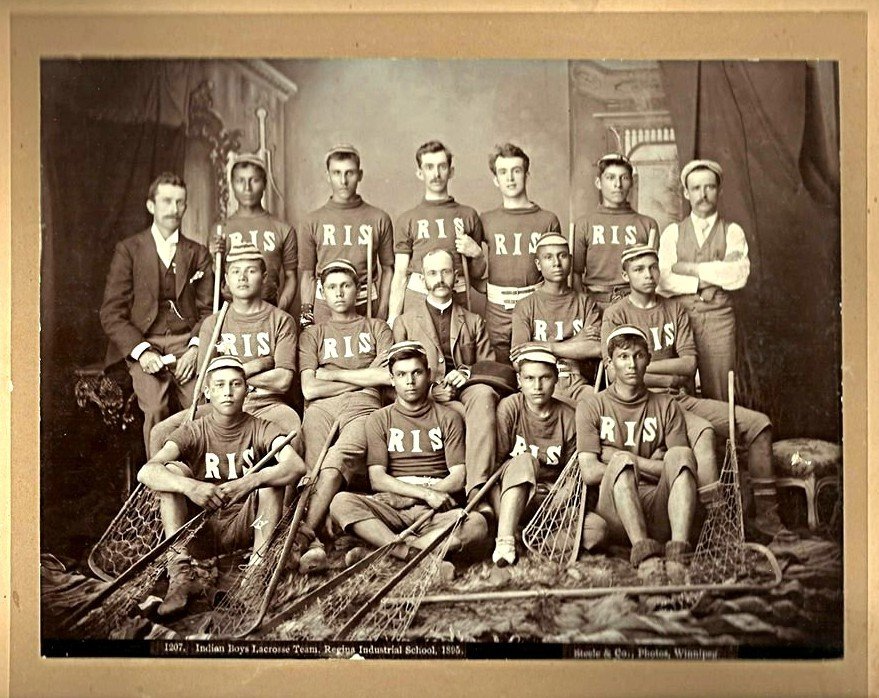
in the winter. The boys had a lacrosse team and fleetness of foot and
keenness of eye soon made them formidable opponents, They had many brilliant
victories.
Lacrosse Team
1895 with coach at right, a teacher (maybe manager) at left and Principal Angus
Jonas McLeod
seated in the centre.
[I see
something extraordinary and I believe it's the body language.
They look so
comfortable with each other. The solemn expressions should not be
misinterpreted,
could have been at the request of the
photographer to be still.]
A
brass band was organized, music was taught, and many fine singers were
developed. Social evenings were spent in games, music and dancing, with staff
and employees joining in. Other evenings were taken up with dialogues,
readings, essays, and recitations. In the summer holidays, camping expeditions
were organized. The girls went first for two weeks, living in tents under
careful supervision. They sometimes camped on the school grounds but usually
went to the Qu’Appelle valley. Then the boys had their turn. Graduation days
were special, when the Indian Commissioner and other honoured guests were present
to see the graduates receive their certificates. Some graduates went back to
their respective reserves, while others got jobs in Regina or in the community.
Many fine reports came back to the school regarding these ex-pupils.
The Regina Industrial School was closed
in 1910 and those of us who are descendants of the pupils often wonder why this
technical school and others like it were not kept open. Had they been
continued, the Indians might be further advanced than they are today.
About Truth
and Reconciliation
By Mary Lynn Milne, May 2026
As a granddaughter of the man who
worked hard as a farmer and farming instructor at two Residential Schools
between 1891 and 1906, the Regina Industrial School and the Brandon Indian
School, I must admit to feeling disappointed that all Residential
Schools have been, and are continuing to be, maligned by the Truth and Reconciliation
Commission, undermining the character of all their administrators, all their
instructors, and all their support staff from the time they first opened in the
1880s until long into the 1990s. It does not advance
successful reconciliation.
Unfortunately,
it is also disappointing that the intent of the Schools seems to have
been cast aside. I have researched the institutions that developed the schools -
the Government and the Church - and there is no doubt they had the best
of intentions. How much could the Government and the Church have really known
about Indigenous nations, which are many and not all the same? Hindsight makes clear their
representatives lacked foresight, weren't fully prepared, weren't
well-informed, couldn't have been. They didn't have the Internet to do a
search, believed they were doing good by sharing their own way of life. Unfortunately,
hindsight is never available at the planning stage.
"Educating
them to be like us" would have been a natural response but must have been
accompanied by some fear of the unknown on both sides. It is important to give
credit to the administrators, instructors and other staff who pioneered
the schools, who most certainly would have tried their best, but our best always
varies from day to day, is dependent on knowledge, health, energy, stress
levels and living conditions. The world was different in the early days of the
Schools, so long ago now. The schools had no telephones, and transportation of
any kind wasn't easily available.
I have included government reports on
this site for the 1899-1900 school year, for both the Brandon
Indian School and the Regina Industrial School, and they are very detailed. For
certain, the Industrial Schools helped children from many Indigenous cultures develop
knowledge, acquire life skills and job skills, learn practical work skills of
gardening, farming, carpentry, sewing, cooking..., so much more than religion
and the English language. But the children would have learned at different
speeds, a common challenge for teachers. To further complicate matters, some children,
instructors and other staff members suffered from fatigue, accidents, illnesses,
and contagious diseases (including scarlet fever and tuberculosis) without
adequate medical care. Some endured extremely cold weather -
and so much snow! Reports indicate some of the children were weak and
malnourished when they were enrolled in the schools; most lacked immunity;
sadly, many died. Some teachers, administrators and support staff also died. The
conditions were far from ideal.
Like my grandfather, I am a teacher,
having taught in Alberta public schools from the mid-1970s
to the mid-1980s before burning out and offering
my skills in less stressful environments. I've also taught English as an
Additional Language (EAL) to teenage and adult students from many countries and
cultures, but not at the beginning level. I don't have the patience for it.
Whenever I read or hear complaints by Indigenous people about Residential
Schools, I wonder how many of them have been employed as teachers or
instructors in schools anywhere, at any time. How many of them
know how much work it is? Children, even if the same age, are not all the same.
Some are not well taken care of at home; some arrive without lunch; some have
had inadequate parenting or guidance; some have been abused; some are not
physically strong; others misbehave in an effort to get attention. Adolescents
tackling hormones can behave irrationally, with teachers needing to spend more
time and expend more energy disciplining than teaching. Yes, I have read
accounts of children being punished in Residential Schools, of instructors
being so overwhelmed and so overtired, unable to reason with children who could
likely understand each others' Indigenous dialects, but were early in the
process of learning English. The accounts are heartbreaking.
I don't have documentation for the
later years, but during a conversation in 1997 with an Indigenous couple, both
Elders, I learned how much they value their Residential School experiences when
they asserted, "We don't know why there's complaining. We wouldn't have
learned to read and write if we hadn't gone there."
With supportive photos and
documentation, I feel it important to respond on behalf of my grandfather and
all the other instructors, administrators and support staff who worked so hard at
Indian Residential Schools in their early days, in difficult conditions, to
help Indigenous children learn skills to improve their quality of life. The
Canadian Government has provided significant monetary compensation to
Indigenous peoples in an attempt to make amends, without requiring proof that all
instructors and all other staff members were guilty of abuse, proof which would
be impossible to supply. The veiled judgement of people who are not here to
defend themselves is hurtful.
It would be naive for me to expect my
comments will stop negative narratives about Residential Schools but when we
notice inaccurate or incomplete information being perpetuated about any
issue and we don't do something to correct it, we become part of it. It would
be willful blindness. It is always easier to ignore an issue than
address it, but valuable results are rarely, if ever, the outcome of ignorance.
Canada
is multicultural, but multiculturism does not produce one big happy cohesive
family. There are differences in ethics, religions, and first languages that don't always translate
well. We don't always agree but we do need to get along, and often to compromise,
especially now when there is so much hatred sweltering in the world.
I am encouraged that some members of Indigenous
nations have expressed their belief about forgiveness (letting go) and
healing being essential steps toward reconciliation. It is a good sign. A
unifying sign. How much better for our country if Canadians focused on the
powers of Cooperation, Strength, Humility, Integrity, Wisdom and Forgiveness,
not as parts of a new movement but as attitudes. Canadians are strong. Surely,
we can do it.
An Added Note from Mary Lynn Milne

|
As a teacher, I am fully aware there are some
bad teachers in the profession, just as there are some bad doctors, bad
lawyers, bad policemen in theirs.... It has been so since the dawn of these and
other professions and will continue to be so. However, to condemn all on the
basis of the actions of a few is both unfair and unreasonable. Teachers must
always be ready to adapt to new students every year, or every semester, and students,
of course, are never all the same. Adapting is often a steep learning curve and
always a lot of work.
My experience as a teacher and trainer of
English and Communication Skills for both native and non-native speakers of
English has given me the opportunity to work alongside teachers with a variety
of backgrounds, and to help many students, mostly teenagers and adults from
many cultures, having a variety of first or additional languages. When I focus
on the positives, I think of it as a wonderful adventure, become aware how much
I've learned that would not be available any other way. Similarly, my five
years in China teaching and training in one autonomous region and three
provinces gave me an understanding of China not available any other way. It
nurtured my work as a freelance writer and writer of educational non-fiction
books, allowing me to share my understanding in An Inside Look at China. If
you are interested in learning about China from my unique and positive vantage
point, you can find it as both an e-book and a paperback on Amazon.ca.
https://www.amazon.ca/Inside-Look-at-China/dp/B098CWD68
|